
By Dr. Sean Olenek, D.C. · Insight Chiropractic Health & Wellness Center, Maitland, FL
Hyperbaric oxygen therapy (HBOT) has gone from a niche hospital treatment to something athletes, executives and people recovering from injury talk about. With that popularity comes a lot of hype. This guide explains what HBOT actually does in the body, what the research supports, and where the evidence is still catching up — so you can decide whether it’s right for you.
What Is Hyperbaric Oxygen Therapy?
During HBOT you breathe concentrated oxygen inside a chamber pressurized above normal air pressure.
Your red blood cells carry most of your oxygen, and in a healthy person they’re already about 97–99% full. Breathing more oxygen at normal pressure can’t fill them much more. Pressure works differently: it dissolves extra oxygen directly into your plasma, the liquid part of your blood. It’s the same reason a sealed soda stays fizzy — pressure keeps more gas dissolved in liquid. Plasma reaches places red blood cells struggle to get to, such as swollen, injured or poorly circulated tissue.
Why Pressure Matters
Pressure is measured in ATA (atmospheres absolute). Sea level is 1.0 ATA.
| Chamber type | Typical pressure |
|---|---|
| Soft-sided “mild” chambers | About 1.3–1.5 ATA |
| Insight’s hard-shell chamber | 2.0 ATA |
| Hospital chambers for emergencies | Often 2.0–3.0 ATA |
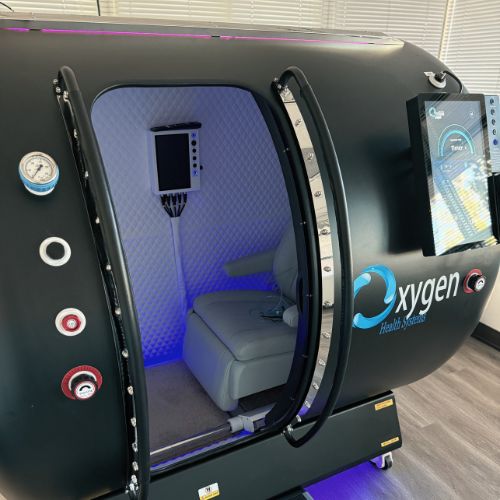
Much of the research in this article was done at 1.5 to 2.0 ATA. Our chamber operates at 2.0 ATA, and you sit upright or recline in a spacious, comfortable space.
What Happens Inside Your Cells
HBOT’s effects go beyond simply “more oxygen.” Three processes explain most of what researchers are excited about.
1. Mitochondria: Your Cells’ Power Plants
Mitochondria turn oxygen and nutrients into ATP, the energy every cell runs on. When tissue is injured, inflamed, or short on blood flow, mitochondria stall and energy production drops. Delivering oxygen to those areas helps them restart.
There’s also evidence that repeated HBOT can strengthen mitochondria over time. In a double-blind, placebo-controlled trial of 37 middle-aged master athletes, 40 sessions at 2.0 ATA increased mitochondrial respiration capacity and mitochondrial mass compared with a sham chamber, along with gains in VO₂max, the gold-standard measure of aerobic fitness [3].
2. A “Good Stress” That Builds Antioxidant Defenses
You may have heard that too much oxygen creates free radicals. That’s true in large, continuous doses. But short, spaced-out sessions work more like exercise: a brief, controlled stress signals your cells to build up their own protective systems. In human blood-vessel cells, HBOT switched on the Nrf2 pathway, the body’s master switch for its own antioxidant and protective genes [1]. This principle is called hormesis — a small dose of stress makes you stronger.
3. The Oxygen “Signal” That Triggers Repair
Cells don’t just sense how much oxygen they have; they sense changes. When oxygen rises during a session and returns to normal afterward, the body reads that drop as a signal to start repair programs — including making new blood vessels and supporting new mitochondria — without any actual oxygen shortage. Researchers call this the hyperoxic-hypoxic paradox [2]. It’s the main reason HBOT is given as a series of sessions, typically 40 or more, rather than once.
Stem Cells and New Blood Vessels
One of the most talked-about effects of HBOT is on stem cells — and it’s worth getting the details right.
Your bone marrow stores stem and progenitor cells, early-stage repair cells that can help build new blood vessels and support healing. In a study at the University of Pennsylvania, a single 2.0 ATA HBOT session doubled the number of these cells circulating in the bloodstream, and over 20 sessions the number rose about eightfold [4]. The mechanism appears to be nitric oxide: HBOT raises nitric oxide in the bone marrow, which acts like opening a gate that releases these cells into circulation.
Two clarifications matter here:
- HBOT mobilizes stem cells rather than creating them. It increases how many are released into the bloodstream, where they can travel to tissue that needs repair.
- More circulating stem cells is a measurement, not a guaranteed outcome. What those cells accomplish depends on the person and the condition.
Alongside stem cells, HBOT stimulates angiogenesis, the growth of new small blood vessels. Better microcirculation means better oxygen and nutrient delivery to tissue that has been injured or has lost blood supply over time.
What HBOT May Help With, and How Strong the Evidence Is
| Area | What studies have found |
|---|---|
| Physical performance and fitness | Higher VO₂max and stronger mitochondria in master athletes; better aerobic capacity in older adults |
| Heart function | Improved heart-muscle strain in post-COVID patients; increased heart blood flow in older adults |
| Stroke recovery | Improved function and quality of life after 40 sessions, years after the stroke |
| Cognitive aging | Better attention and processing speed in healthy older adults |
| Concussion / mild TBI | Positive trials, but one military trial found no difference from a placebo chamber |
| Long COVID | Improved cognition, energy, sleep and pain vs. a placebo chamber |
| Fibromyalgia after brain injury | Greater pain reduction than standard medications |
| Hospital-approved uses (wounds, CO poisoning, etc.) | Established medical indications |
Heart and Circulation
HBOT is not a treatment for heart disease, but early research on heart function is interesting. In a randomized, double-blind, sham-controlled trial of post-COVID patients, 40 sessions improved global longitudinal strain, a sensitive echocardiogram measure of how well the heart muscle contracts, in patients who started with reduced function [5]. In a separate randomized trial of 63 sedentary adults over 64, HBOT increased blood flow to the heart muscle on MRI, along with gains in aerobic capacity [6]. A scientific review also describes how HBOT acts on the same pathways involved in reperfusion injury, the damage that can occur when blood flow returns after a heart attack or procedure [7].
If you have any heart condition, we coordinate with your cardiologist before you start. Heart failure, recent cardiac procedures, and pacemakers or defibrillators all require clearance.
Brain Health
Studies have shown improvements after stroke [8] and in cognitive aging [9], with more mixed results for concussion [10]. We cover the brain research in depth in our post, Hyperbaric Oxygen Therapy Supports Brain Health.
Performance, Energy and Healthy Aging
The master-athlete trial described above found higher VO₂max and improved mitochondrial function compared with a sham chamber [3], and the older-adult trial found better aerobic capacity and heart blood flow [6]. For active adults and athletes, this is one of the most interesting areas of HBOT research.
Long COVID
In a randomized, double-blind, sham-controlled trial of 73 people with symptoms lasting at least three months after COVID, 40 HBOT sessions improved cognitive function, energy, sleep, psychiatric symptoms and pain compared with a placebo chamber, with matching changes on brain MRI [11].
Fibromyalgia
In people whose fibromyalgia began after a brain injury, a randomized trial found 60 HBOT sessions reduced pain more than standard fibromyalgia medications (pregabalin or duloxetine), with improvements in quality of life [12]. This study focused on a specific group, so results may not apply to everyone with fibromyalgia.
Hospital-Approved Uses
Insurance-covered HBOT is reserved for a specific list of conditions, including carbon monoxide poisoning, decompression sickness, non-healing diabetic wounds, radiation injury, and failing skin grafts or flaps. These are treated in hospital hyperbaric units, often at higher pressures, and that’s where those patients belong.
What to Expect at Insight
- Our chamber: 2.0 ATA hard shell. You sit upright or recline, and the spacious design keeps most people comfortable.
- Sessions: 60 minutes. Many patients read, rest, meditate, or answer email.
- How many: most of the research above used 40 to 60 sessions. We’ll recommend a plan based on your goals.
- How it feels: ear pressure, like an airplane descending, while the chamber pressurizes. We’ll show you how to clear your ears.
- Safety screening: we review your health history and medications before your first session. Some conditions need your physician’s clearance first, including heart failure, recent heart procedures, pacemakers and other implanted devices, seizure history, certain lung conditions, and some medications.
- Working with your doctors: we’re glad to coordinate with your cardiologist, neurologist or primary care physician, including before-and-after testing.
Learn more about our hyperbaric oxygen therapy program.
Ready to See if HBOT Is Right for You?
Whether you’re recovering from an injury, managing lingering post-COVID symptoms, or looking to support your energy and performance as you age, we’d be happy to talk through your goals.
Or call (321) 926-2997.
Insight Chiropractic Health & Wellness Center · 1551 Sandspur Road, Suite 101, Maitland, FL 32751
This article is for educational purposes only and is not medical advice. Hyperbaric oxygen therapy is not a cure for any disease, and individual results vary. Many of the studies described are small and come from a limited number of research centers. Talk with your physician before starting any new therapy.
References
- Godman CA, et al. Hyperbaric oxygen induces a cytoprotective and angiogenic response in human microvascular endothelial cells. Cell Stress Chaperones. 2010. doi:10.1007/s12192-009-0159-0
- Hadanny A, Efrati S. The hyperoxic-hypoxic paradox. Biomolecules. 2020. doi:10.3390/biom10060958
- Hadanny A, et al. Effects of hyperbaric oxygen therapy on mitochondrial respiration and physical performance in middle-aged athletes: a blinded, randomized controlled trial. Sports Med Open. 2022. doi:10.1186/s40798-021-00403-w
- Thom SR, et al. Stem cell mobilization by hyperbaric oxygen. Am J Physiol Heart Circ Physiol. 2006. doi:10.1152/ajpheart.00888.2005
- Leitman M, et al. The effect of hyperbaric oxygen therapy on myocardial function in post-COVID-19 syndrome patients: a randomized controlled trial. Sci Rep. 2023. doi:10.1038/s41598-023-36570-x
- Hadanny A, et al. Physical enhancement of older adults using hyperbaric oxygen: a randomized controlled trial. BMC Geriatr. 2024. doi:10.1186/s12877-024-05146-3
- Francis A, Baynosa R. Ischaemia-reperfusion injury and hyperbaric oxygen pathways: a review of cellular mechanisms. Diving Hyperb Med. 2017. doi:10.28920/dhm47.2.110-117
- Efrati S, et al. Hyperbaric oxygen induces late neuroplasticity in post stroke patients — randomized, prospective trial. PLoS One. 2013. doi:10.1371/journal.pone.0053716
- Hadanny A, et al. Cognitive enhancement of healthy older adults using hyperbaric oxygen: a randomized controlled trial. Aging. 2020. doi:10.18632/aging.103571
- Miller RS, et al. Effects of hyperbaric oxygen on symptoms and quality of life among service members with persistent postconcussion symptoms. JAMA Intern Med. 2015. doi:10.1001/jamainternmed.2014.5479
- Zilberman-Itskovich S, et al. Hyperbaric oxygen therapy improves neurocognitive functions and symptoms of post-COVID condition: randomized controlled trial. Sci Rep. 2022. doi:10.1038/s41598-022-15565-0
- Ablin JN, et al. Hyperbaric oxygen therapy compared to pharmacological intervention in fibromyalgia patients following traumatic brain injury: a randomized, controlled trial. PLoS One. 2023. doi:10.1371/journal.pone.0282406