
By Dr. Sean Olenek, D.C. · Insight Chiropractic Health & Wellness Center, Maitland, FL
Red light therapy has gone from a clinic treatment to something sold in every form imaginable — masks, panels, wands, whole-body beds. Some of the claims around it are well supported. Many are not. This guide explains what red light actually does inside your cells, what the research genuinely shows, and where the evidence is still thin, so you can judge it for yourself.
What Is Red Light Therapy?
Red light therapy — researchers call it photobiomodulation — uses specific wavelengths of red and near-infrared light to influence how your cells produce energy. It is not a laser treatment, it does not use UV light, and it does not heat or burn tissue.
Two wavelength ranges do most of the work:
| Wavelength | What it is | Where it acts |
|---|---|---|
| Red, roughly 630–660 nm | Visible deep red light | Closer to the surface — skin, superficial tissue |
| Near-infrared, roughly 810–850 nm | Invisible to the eye | Penetrates deeper — muscle, joints, connective tissue |
Our system uses both. We run PlatinumLED BioMax Pro panels — four boards on an adjustable stand that raises and lowers to match your height — emitting a multi-wavelength spectrum that spans visible red (630 and 660 nm) and near-infrared (810, 830 and 1060 nm). That range means one session reaches skin and deeper tissue at the same time, rather than targeting only one or the other.
How It Works Inside Your Cells
The mechanism is better understood than most people assume.
Inside your mitochondria sits an enzyme called cytochrome c oxidase, the last step in the chain that turns oxygen and nutrients into ATP, the energy your cells run on. When cells are stressed, inflamed or short on oxygen, nitric oxide builds up and binds to that enzyme, slowing it down.
Red and near-infrared light are absorbed by exactly that enzyme. The leading explanation is that the light displaces the nitric oxide that had been blocking it, letting oxygen back in and allowing electron transport and ATP production to pick back up [1]. Downstream of that, the cell activates signalling pathways tied to repair, reduced inflammation and its own antioxidant defences.
Dose Matters More Than Intensity
This is the part most marketing gets wrong. Photobiomodulation follows a biphasic dose response — too little light does nothing, and too much can actually reduce the effect. A systematic review of 46 clinical trials covering more than a thousand participants mapped out effective ranges and found that both the dose and the timing changed the result [3].
Translated: longer sessions and stronger devices are not automatically better. A measured dose from a clinical system is more useful than guessing with a consumer device.
What the Research Supports
Skin Quality and Collagen
This is the strongest consumer-facing evidence. In a controlled trial of 128 volunteers, 30 sessions of red or red-plus-near-infrared light produced measurable improvements in skin roughness measured by profilometry, increased intradermal collagen density measured by ultrasound, and visible reductions in fine lines and wrinkles confirmed by blinded evaluation of photographs against an untreated control group [2].
Worth noting what makes that study credible: the outcomes were instrument-measured and the photo assessment was blinded, rather than relying on how participants said they felt.
Muscle Recovery and Soreness
A 2025 systematic review and meta-analysis of 14 controlled studies found that light therapy produced a significant reduction in soreness at 72 and 96 hours after muscle-damaging exercise, with moderate effect sizes, alongside improved muscle strength recovery at 24 and 48 hours [4].
The broader review of muscle research also found reduced creatine kinase — a blood marker of muscle damage — improved fatigue resistance, and better work output, with a notable finding on timing: light applied several hours before exercise outperformed applying it immediately beforehand [3].
Pain and Joint Function
Here the evidence is real but more measured, and worth setting out carefully. A 2024 systematic review with meta-analysis in Physical Therapy found that photobiomodulation can reduce pain and improve disability in knee osteoarthritis — but the authors concluded that the very low certainty of the evidence does not support recommending it on its own, and that it is better used to complement other established treatments [5].
That matches how we use it: alongside chiropractic care, soft-tissue work and movement, not instead of them.
Where the Evidence Is Thinner
Being useful means saying what red light does not have strong support for:
- Weight loss and fat reduction. Marketed heavily, supported poorly.
- One-session results. Nearly every study showing benefit used a series of sessions over weeks. Single-session claims do not reflect how the research was done.
What a Session Is Like at Insight
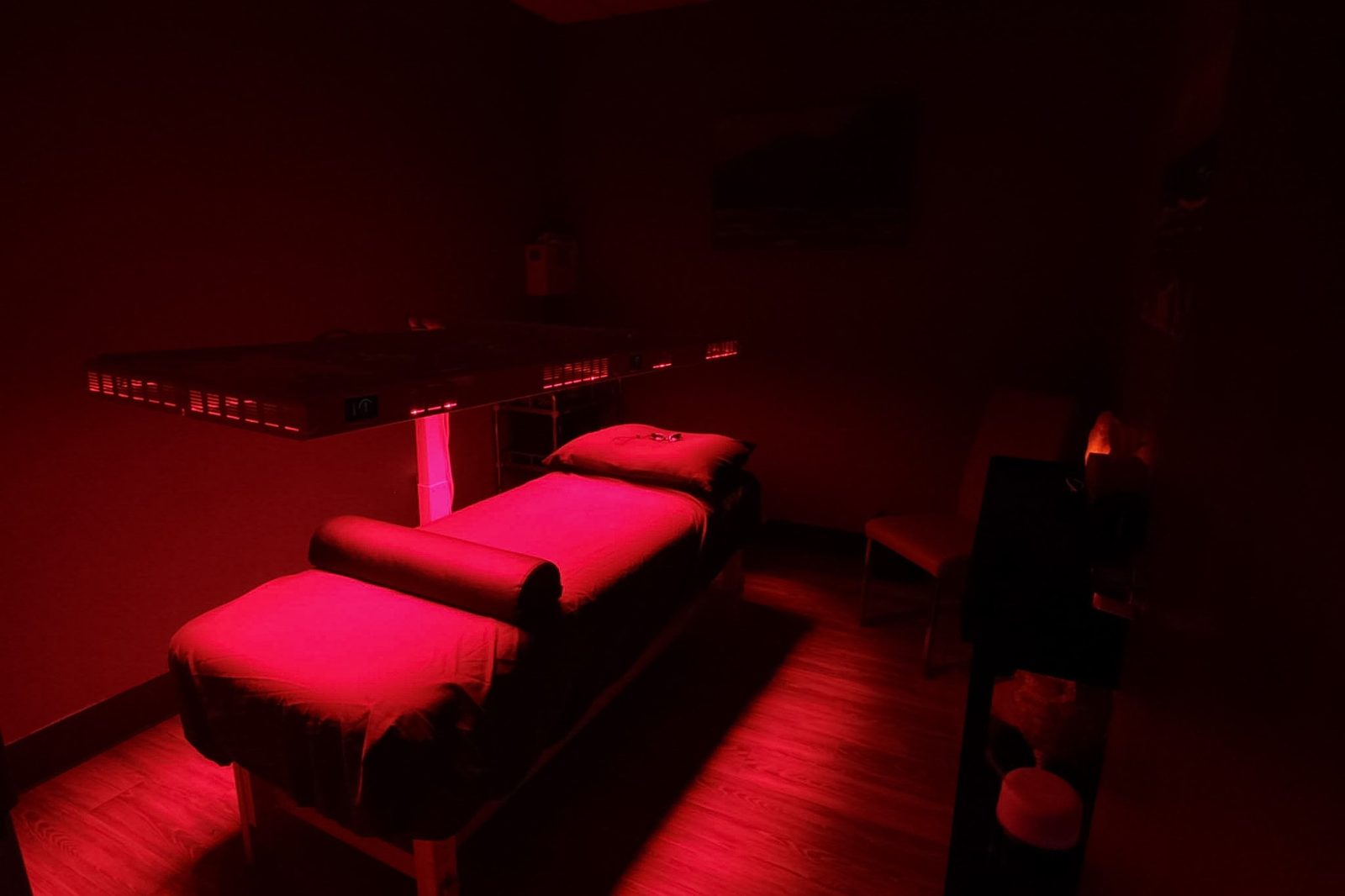
- Two dedicated rooms, each with a four-panel PlatinumLED BioMax Pro array on an adjustable stand set to your body size.
- 15 minutes on your back, then 15 minutes on your front. Light only works where it lands, so we cover both sides rather than treating one area.
- As much skin exposed as you are comfortable with. Light does not pass through clothing, so coverage is what determines your dose.
- No sensation beyond gentle warmth, and no downtime. No UV, no tanning, no recovery period — people come on a lunch break.
- Eye protection provided.
- Run by our front desk. You do not need an appointment with the doctor — book a session on its own or add it to a visit.
- Series, not one-offs. Most research uses two to three sessions a week over several weeks. We will suggest a schedule based on your goal, whether that is skin, recovery or working alongside treatment for pain.
Many patients pair it with chiropractic care, Acupuncture or hyperbaric oxygen therapy, which is where we tend to see people get the most out of it.
Who It Is Not For
Tell us before your first session if you are pregnant, have a history of skin cancer, are photosensitive, or take medication that increases light sensitivity — some antibiotics, acne medications and diuretics do. We will talk it through and, where appropriate, check with your physician first.
Ready to Try It?
We are in Maitland, FL, a few minutes from Winter Park, Altamonte Springs and north Orlando. If you are curious whether red light therapy fits what you are working on, we are happy to talk it through honestly — including telling you when it is not the right tool.
Or call (321) 926-2997. Check our current specials for first-session offers.
Insight Chiropractic Health & Wellness Center · 1551 Sandspur Road, Suite 101, Maitland, FL 32751
This article is for educational purposes only and is not medical advice. Red light therapy is not a cure for any disease, and individual results vary. Talk with your physician before starting any new therapy.
References
- Freitas LF, Hamblin MR. Proposed mechanisms of photobiomodulation or low-level light therapy. IEEE J Sel Top Quantum Electron. 2016;22(3):7000417. doi:10.1109/JSTQE.2016.2561201
- Wunsch A, Matuschka K. A controlled trial to determine the efficacy of red and near-infrared light treatment in patient satisfaction, reduction of fine lines, wrinkles, skin roughness, and intradermal collagen density increase. Photomed Laser Surg. 2014;32(2):93–100. doi:10.1089/pho.2013.3616
- Ferraresi C, Huang YY, Hamblin MR. Photobiomodulation in human muscle tissue: an advantage in sports performance? J Biophotonics. 2016;9(11–12):1273–1299. doi:10.1002/jbio.201600176
- Tsou YA, Chang NJ, Chang WD. Effects of photomodulation therapy for delayed onset muscle soreness: a systematic review and meta-analysis. J Funct Morphol Kinesiol. 2025;10(3):277. doi:10.3390/jfmk10030277
- Oliveira S, Andrade R, Valente C, et al. Effectiveness of photobiomodulation in reducing pain and disability in patients with knee osteoarthritis: a systematic review with meta-analysis. Phys Ther. 2024;104(8):pzae073. doi:10.1093/ptj/pzae073