
Written By Insight Chiropractic Health and Wellness Center on October 2nd, 2026
October is National Chiropractic Health Month, so I want to talk about one of the most common things I see in patients: sitting.
A lot of my patients spend most of their day in a chair. At a desk, in the car, on the couch at night. And the same complaints keep coming up: low back pain, tight hips, and stiffness that’s worst when they finally stand up.
We weren’t built for this
Biologically, our bodies weren’t designed for this much sitting. Our ancestors sat differently. They knelt, squatted, and shifted between natural stretching positions. They kept moving.
Today most of us sit in one stationary position for hours, in front of a computer or behind the wheel. Your body adapts to whatever you do most. If what you do most is sit still, it adapts to that.
What sitting does to your hips and low back
Here’s what’s going on, in plain English.
When you sit, your hips stay bent. Over time, the muscles at the front of your hips, your hip flexors, get short and tight. The big one is the psoas, a deep muscle that connects your lower spine to the top of your thigh. Meanwhile your hamstrings, along the back of your thighs, tighten up too.
When the muscles on the front and the back of your hips both get tight, they pull your pelvis out of balance. And your pelvis is the foundation your spine sits on. When the foundation is off, your low back picks up the slack. That’s the low back pain and stiffness so many desk workers live with.
Your body is smart. It works around the problem by building compensation patterns: some muscles overwork, others quiet down. That gets you through the day, but it usually isn’t comfortable, and it tends to stick around.
“I got a standing desk. Why does my back still hurt?”
I hear this a lot. Not long ago, a patient who sits at a desk most of the day came in with low back pain. They had already switched to a standing desk, thinking it would solve the problem. It didn’t.
Standing changed the position of their body. But it didn’t build the foundation of strength and stability their body needed to hold that new position well. The same tight, unbalanced patterns just came along for the ride, now standing up.
A standing desk can be a good tool. It just isn’t a fix on its own.
How I approach it
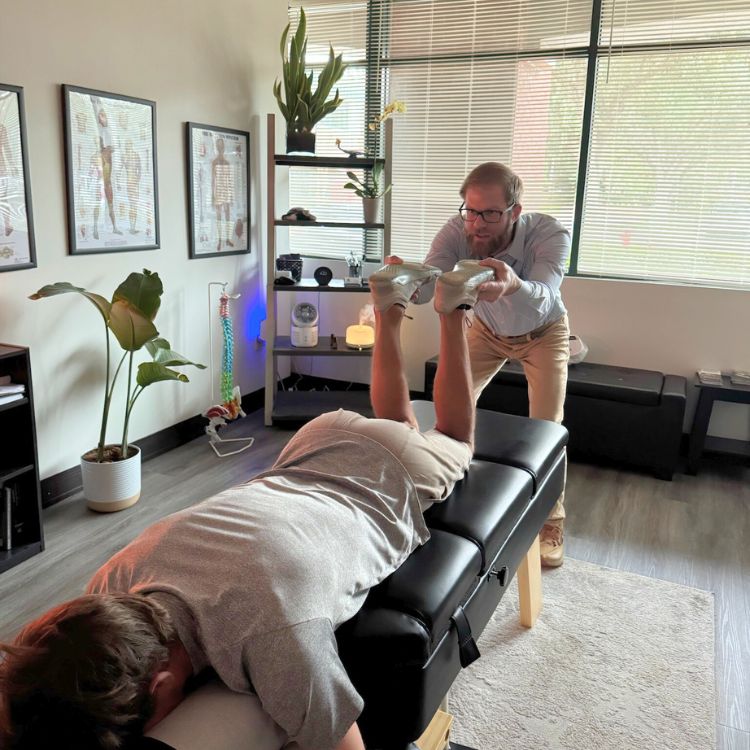
The technique I practice is called Applied Kinesiology. It lets me test individual muscles, like the psoas and the hamstrings, to see where your body has built those compensation patterns. I also test the ligaments that connect your pelvis to your spine, like the iliolumbar ligament, and work on balancing the pelvis so the whole system works better together.
That gives us a very thorough approach. The goal is to help ease the discomfort, tightness, or pain you came in with, and at the same time reconnect the signals to areas that have been “turned off,” so your body’s natural mechanisms for balance and stability can do their job again. With that foundation in place, a healthier posture gets a lot easier to hold, sitting or standing.
Three things you can do today
Whether or not you ever come see me, these help:
1. Raise your screen to eye level. If I could get every desk worker to do one thing, this would be it. We’re wired to keep our eyes on the horizon. That’s the natural position for your head and eyes. When your screen sits low, your head follows it down all day. A stack of books under a laptop works fine.
2. Take breaks. If you sit for long stretches, get up and move regularly, even for a minute or two. Breaks keep your muscles from staying contracted and locking in those compensation patterns.
3. Keep your chin up when you text. Dropping your chin to your chest to look at your phone flattens the natural curve in your neck and strains the muscles and soft tissue there. Bring the phone up to your eyes instead.
When to come in
If long days of sitting have left you with low back or hip pain, or a standing desk didn’t do what you hoped, let’s take a look. Many patients find that once the pelvis is balanced and the right muscles are firing again, sitting (and standing) feels a lot better.
Dr. Sean Olenek, D.C., Insight Chiropractic Health and Wellness Center, Maitland, FL